

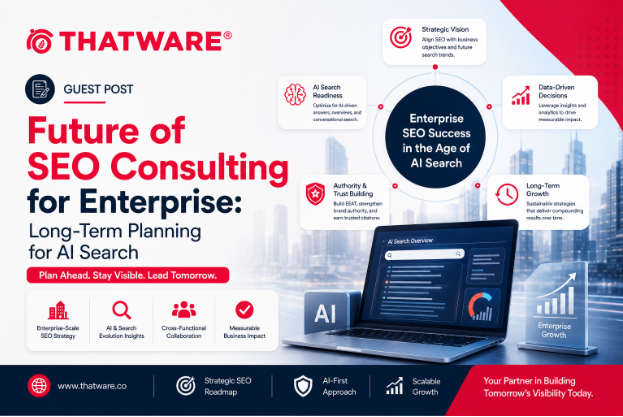
Enterprise SEO has always been a different animal from small business or agency SEO. The scale is different — thousands or millions of pages rather than dozens. The stakeholder complexity is different — marketing, legal, IT, product, and executive teams all have opinions. The timeline is different — changes that take a week for a small site can take a quarter for an enterprise.
All of those structural realities persist. And now they’re compounded by the need to plan for a search landscape that’s evolving faster than most enterprise planning cycles can accommodate.
Long-term planning for enterprise AI search requires a specific kind of strategic thinking — one that accounts for both the near-term tactical shifts and the longer-arc transformation in how search works.
The Enterprise AI Search Challenge
Large enterprises have a structural advantage and a structural challenge when it comes to AI search.
The advantage: enterprise brands typically have substantial domain authority, extensive content libraries, and the resources to invest in the quality and technical infrastructure that AI search requires. A major financial institution, healthcare system, or technology company already has the kind of E-E-A-T signals that AI systems favor.
The challenge: organizational inertia. Large companies move slowly. Content governance processes, legal review requirements, and cross-departmental coordination can make it difficult to respond quickly to search landscape changes. The enterprise that identified the AI search shift eighteen months ago and immediately began adapting is in a fundamentally different position from the one that’s just now commissioning a strategy review.
Future of SEO consulting for enterprise focuses on building adaptive capacity within organizational constraints — designing content programs, governance structures, and technical architectures that can respond to an evolving AI search environment without requiring a complete overhaul every time Google changes something.
The Long-Term Planning Framework
Effective enterprise AI search planning operates on multiple time horizons simultaneously.
The near-term horizon (0-6 months) addresses immediate gaps: structured data implementation, content quality improvements on highest-traffic pages, author and entity signal development, GBP and citation consistency audits.
The medium-term horizon (6-18 months) builds systematic capability: developing topical authority programs, launching original research initiatives, building the content production infrastructure for AI-optimized content at scale, establishing AI citation monitoring.
The long-term horizon (18+ months) focuses on structural positioning: building the brand authority that makes your enterprise a default reference for AI systems in your category, developing proprietary data assets, and building the organizational capability for ongoing AI search adaptation.
Hire future of SEO expert talent or consulting teams that understand all three horizons — and can build strategies that balance short-term performance with long-term positioning. The enterprise brands that will dominate AI search in 2028 are making strategic investments now that won’t fully pay off for eighteen months. That patient, long-term orientation is exactly what enterprise SEO planning requires.